Showing posts with label r.i.p.. Show all posts

Thursday, May 31, 2012

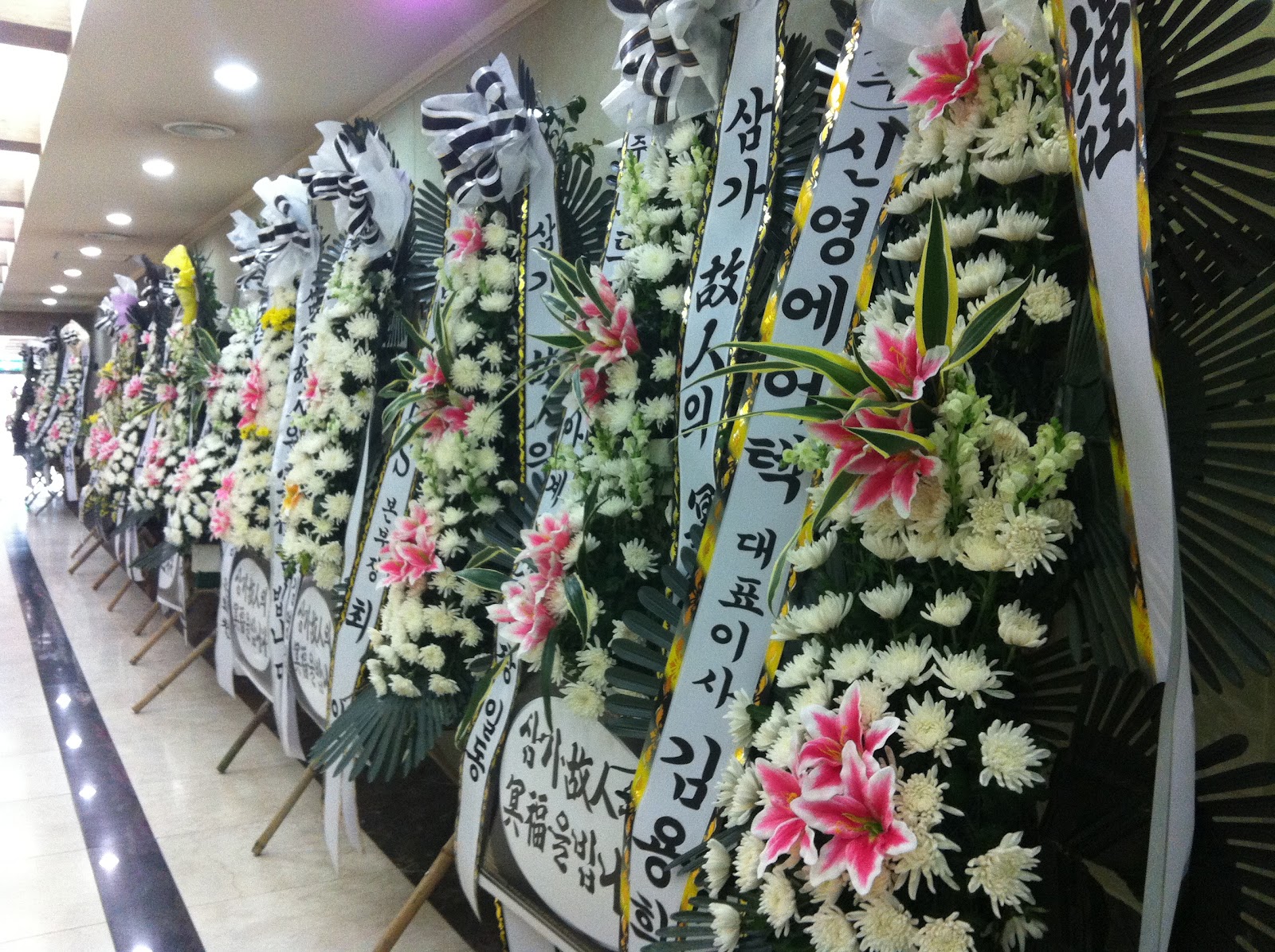
R.I.P. 할아버지

My maternal grandfather passed away on Sunday at the age of 91 (he was 89 by American age reckoning).

After a very long life with five children and twelve grandchildren, he went quickly and without losing much of his sharp mind. What a life he's lived. And what a gracious gentleman he was, to the very end. He didn't suffer very much and he didn't cause others too much suffering with his passing.
The funeral process in Korea is very different from what I'm accustomed to from America. It's much longer and involves a lot more people. I was a little bit surprised by the amount of time we spent, as a family, in the funeral home.

I flew from LA to Korea on Friday (leaving on Thursday from LA and landing in Korea on Friday evening) and then spent Saturday in a jet-lagged daze. Because Monday was a public holiday in Korea (Buddha's birthday), I had planned to go down to Jeonju (my hometown) on Sunday and come back up to Ilsan on Monday, so that I could go into the office on Tuesday.

On Sunday morning, I woke up really early (thanks, jet-lag, thanks) and was surprised when my mother rang me up around 7:30 in the morning. My grandfather had passed away at 6:53.

The only cousin that I have that's older than me met me in Seoul so we could go down to Jeonju together. I threw some things in a bag, packed up all my electronics, and rushed over. We got to Jeonju in the afternoon and went straight to the funeral home, to my surprise.

What surprised me even further was that we, the family, were supposed to stay in the funeral home for three days. It's like sitting shiva for Jews, that's the closest equivalent I can think of. I've never been to a wake in the States, I've only ever attended funerals, so perhaps wakes are similar.

People come to the funeral home as they have time to pay their final respects. Younger members of the family (my generation, the grandchildren) greet guests at the front, where there's a handy desk with a guestbook, parking validation stamp, and locked box for envelopes of money (Koreans give money at weddings and funerals).

The guests generally came in, signed the guestbook, dropped off their envelopes of money, removed their shoes, and entered into the room where a large photograph of my grandfather sat among flowers. Some people performed deep bows (getting down on hands and knees), some people bowed their heads, some people took one of the white flowers and put them on the table in front of my grandfather's photograph, some people prayed; there were a variety of ways to pay respect.

There was always at least one male family member in the room, as after a guest pays their respects, one of the family members must be there to greet them, shake hands, accept condolences, and so forth. The family member then asked the guest to stay for a meal, and the guest moved into the next (large) room, which was set up like a restaurant.

Guests ate, some of them drank, my oldest uncle's proteges (he's a music professor) and some of the younger cousins acted as waiters, and we all shared stories about my grandfather. It's nice to say goodbye in that way, but it's also exhausting, to be honest.

The grandsons stayed at the funeral home all night long for two nights, because some guests arrived very late and it's bad form for no one to be there. The poor boys didn't get much sleep for two days-- though those of us that went home didn't get much sleep, either.

The funeral home, which is on the campus of a university hospital, is equipped for Korean funerals. There are black clothes for rent, including traditional Korean clothing, there are armbands for male family members (different stripes according to their relation to the deceased), there are candles (two were kept burning at all times), incense and incense holders for Buddhists, a safe in the back room (for the money), a shower, towels, a kitchen, kitchen staff that cooks and prepares all the food, and so on and so forth.

It's a huge production, to get a Korean funeral done. There's a saying that the people who take care of the funeral fall ill, and I now understand why they say it. For three or four days, there is no sleeping, sporadic meals, and then the constant grief.

Sunday passed in a whirl of guests, many of them acquainted with my parents and shocked at the fact that I'm fully grown. We didn't get home (I went to my oldest uncle's house, where my grandfather lived) until past midnight, everyone exhausted and looking awful.

Monday was a frightening day because it was the day that the funeral home prepares the body, during which family members are expected to participate. Turns out, participation is confined to spectating, other than when three of the guys had to help move my grandfather into his coffin and then all the males of the family carried the coffin out.
It's surreal to watch someone that you've loved all your life being cleaned and dressed in the clothing of funeral rites. It's even more surreal that he looked so much like my beloved grandfather but he wasn't moving, wasn't breathing, wasn't speaking, wasn't doing any of the things that I'd come to expect from him.

Because of his long life and his relatively easy passing, we had all managed to contain our tears. Many of my family members cried as we watched my grandfather being prepared for cremation and burial. It was the last time that any of us were ever going to see his face again.

On Tuesday, after I'd pumped myself full of Red Bull, we went to the funeral home for the last time, very early in the morning. We had a final service there before the coffin was transported to the cremation site, a depressing building full of surly workers and exhausted mourners.

The cremation took an hour and a half, a very short amount of time to reduce an entire person into an urn of ashes.

We took the urn and drove to the mountain where my great-grandparents are buried. My grandfather was buried beside his wife. They share one plaque.
The weather was sunny with soft breezes. Roses, my grandfather's favorite flower, were blooming all along the path up to his grave. It felt like his way of telling us that he was at peace and that it was okay to let go. He would have loved those roses, the weather, the fact that so many members of the family were together.

I hope he's with my grandmother. They haven't seen each other in seven years.

Read more...

Monday, October 31, 2011

R.I.P. Christopher Ryan Smith

I was, for a while, so perplexed about this ... person ... that I didn't know if I wanted to blog about him. I didn't know if I wanted to add more words onto the internet about this man, who saddens me and angers me in turns.

I thought about it for a while. I talked to my mother about it. (She was at my place for the past two nights. I put her (and all seventy pounds of her luggage) into a cab this morning, packing her off to our hometown of Jeonju (전주)). I dwelt on it for longer than would be considered healthy. And I decided to write about it.

Writing and blogging is, in my opinion, one of the healthiest ways to express one's viewpoint. I like writing because nobody interrupts me; nobody can interject and make me lose my train of thought. I can go back and revise (though I rarely do). I can write something up, save it, and re-read it before posting. I can put as little or as much thought as I want into a blog post. Don't come back and yell at me if you have a fanatical point of view and put it up on the internet, though. People will always respond to fanaticism with a corresponding amount of vitriol.

So, here goes!

I remember seeing his picture, though I couldn't say where or when that was (I think it was while I was in Korea, and I think it was via Twitter). I remember thinking, what a ding-dong, and moving along with my day. There are a lot of news articles that enter my brain in snippets, thanks to Twitter, Facebook, and the internet.

This particular case was about a murder. I only recalled the case very vaguely until my mother told me about it yesterday and I investigated it a bit further today, and now my head is reeling.

First off, here's the blog post he wrote on June 23, 2011, just a few short months ago:

For those of you who have known me a long time, you'll agree that my life has been nothing short of a roller coaster ride. Though most of it was self imposed through a series of bad decisions guided by bad judgment, I can safely say that I am happy to be here. Regardless of the outcome, at the end of the day it's only about two things: 1. Your family and circle of friends and 2. Your faith.

1. My Family. I have three beautiful children, an amazing wife and another baby boy that's due in August. There's nothing more I could ever ask for as a human being other than the salvation of God's grace and His son. My kids are wonderful and despite the challenges of raising three kids that are seven and under, I couldn't imagine ever letting this get away from me as I have tried to let happen before.

2. My Faith. I will publicly admit all of my wrongdoing. I have made many mistakes in life, most of them in business and lot directly against my wife and family. I can't argue that God has blessed me with tremendous talents, but the issue hasn't been about execution or growth. It's been about taking shortcuts and looking for shortcuts when in trouble to get out of it. Additionally I think the whole "isolationist" perspective is not a good one to have. When you are on the top by yourself, it's very lonely and when you are immature and ill equipped to handle conflict because of character and under-developed integrity issues, you make mistakes, and in my case, more often than not. In the end, as I look upon my life and live it with a heavy heart knowing the people that I've hurt along the way, I can only hope to try and rectify everything in some small measure and know that in God's eyes that was good enough and that I'm good enough for him. My salvation through Jesus Christ is the ultimate gift, because no matter what, no matter if you are a hardened killer hanging on the cross just a few hours away from your death or born into a good Christian home whose family guides you to Jesus before you even commit serious sins, we are all people. People worthy of being saved by a higher power who was our Creator. Someone who "so loved the world that He gave his only begotten son..." So yes, I'm sorry. And yes, one day I will make good the best way that I can on the things I've done. I can't say when, but hopefully sooner than later.

The irony of all of this is that I could have chosen a different path or train of thought. However, in the end, I have to accept the fact that it isn't my power that has brought me here to where I can still have my family and love others, it's God's power. So because of that, I will take no credit and only offer my thanks and praise to God.
So. He's pushing the Christianity a bit hard, but nothing that stands out and screams that the author is a complete psychopath, right? I was a little surprised at how remorseful and sentimental the author seemed to be in this post, the only post on his blog, titled Mr. Shincredible. I fully expect that blog to be taken down shortly, which is why I've added the entire blog post above.

Mr. Shincredible is, in fact, Edward Younghoon Shin. He murdered his business partner, Christopher Ryan Smith, and covered it up for a year. A YEAR. There are two articles in the LA Times online, one on September 1, 2011, and the other on September 7, 2011. I am all for "innocent until proven guilty," but the man confessed. He killed his business partner, most likely because he didn't have the $1 million to buy out his partner's half of their marketing business.

I am perfectly aware that one million dollars is a very large amount of money. My life, the average life, is worth far more. To Christopher Ryan Smith's family, Chris is worth much more than one million dollars. They still don't have his body, because Edward Shin hasn't told the police where to find it.

The fact that Edward Shin had enough humanity in him to write that blog post? That's what makes me pity him. The fact that he killed a man because of financial gain? That's what makes me hope he gets a tough prison sentence. The fact that he has four children? That just makes me sad. For his wife, for his kids. Especially for the kids- their only wrongdoing was their inability to choose their own father, after all.

To recap the murder, here's what I've gleaned, sorted chronologically:

May, 2010: Edward Shin is convicted in Riverside of embezzling money. He is fined $700,000 and put on probation.

June 4, 2010 (or thereabouts): Edward Shin kills Christopher Smith and disposes of his body and some of his belongings, including his car.

June, 2010 (post-murder): Edward Shin hijacks Christopher Smith's e-mail account to e-mail Smith's family and friends about going on an African adventure. These e-mails continue for some time.

December, 2010: Edward Shin sends the last forged e-mail from Christopher Smith's e-mail account, telling Smith's family that he's on his way to Congo and Rwanda. This e-mail is vague and probably purposefully worrisome, seemingly because Shin wants Smith's family to believe that Smith died in Africa.
June 23, 2011: Edward Shin writes his only blog post. Possibly feeling the noose tightening as police are investigating him?

August, 2011: Christopher Smith's Range Rover is found in San Jose, about 400 miles from where he was killed.

August 28, 2011: Edward Shin is arrested on board a plane bound for Canada, taken into custody, and confesses to murder.

There's some inconsistencies in information about whether Edward Shin has three children or four (his blog post seems to indicate four, in my opinion, but most news articles seem to say he's a father of three), but regardless, he's definitely married and has kids. According to his blog, his youngest is a boy that was born in August. He's religious, obviously, and attends one of the mega-churches in Southern California that is predominantly Korean and Korean-American. (Reading that Wikipedia article, by the way, may shed some light for those who need examples of the lemming mentality that Koreans have.)

I understand, in my little brain, what might motivate a person to murder someone. Really, I get it. People can be stupid and infuriating, and I've said, "I'm gonna kill him/her" more than once in my life. Some people seem to defy Darwinism, in that I don't understand how they're still alive and breathing.

What I do not understand, will never understand, is actually being able to perform the deed. Can you imagine pointing a gun at someone, a real gun, and pulling the trigger? Holding a knife to someone and applying enough force to literally tear their flesh? I really doubt that, no matter how angry someone makes me, I would be able to do more than hit them (I've never punched anyone in my life, but I have hit people, mostly in jest). I don't think I could even put Visine in someone's drink, much less poison.

I am writing about this because of his blog post. There are murders on a daily basis- an hourly basis. I don't think I've ever read something that a murderer has written before he was incarcerated. I know murderers (and other criminals) tend to write letters and appeals once they're in prison and want support or public understanding or whatever, but I've never seen a criminal's blog, written of their own free will, before the public knew anything about them or their grisly crime(s).

They say (I don't know who "they" is, don't ask me) that people tend to become deeply religious on their deathbed, scared of dying without forgiveness, willing to try and ask for redemption before their bodies give out on them. This blog post seems like that sort of thing. Edward Shin is preemptively confessing his sins, hoping that putting his thoughts out there in the universe will somehow lessen his guilt. He compares himself to the two criminals that were crucified alongside Jesus- though to my knowledge, the two were thieves, not murderers. I'm sure he's hoping that he will be the "good thief," the one who was forgiven by Jesus, rather than the "bad thief," who mocked Jesus to the end.

I'm not going to further dissect this. I like analyzing things, but I have a feeling that dwelling on this for too long isn't going to do good things for my mental health, which is already teetering due to long, blood-sucking hours at work.

It's Halloween in Korea today, which means that it's just another autumn day in Korea today. Sadly, Halloween isn't much of an event here. I only remembered that it was Halloween because I went out with a few co-workers on Friday and I took them to a couple foreigner bars, where people were in (half-hearted) costumes. There was even an apple bobbing tub in one bar, which was a funny thing to introduce to Koreans (they think it's a weird game, which is perfectly understandable).

Nobody is dressed up at work today, and nobody's handing out candy. Sigh.

Read more...

Thursday, March 24, 2011

R.I.P. Elizabeth Taylor

I thought Elizabeth Taylor would live into her 100's. She had that grande-dame-dripping-with-diamonds essence to her that made me think she would just keep going.

I've only watched a couple of her movies, but she was a legend for her beauty, rightfully so. There's nobody that's really ever had the same look, the same style.

I know she suffered a lot of health problems, so I hope she is at peace. I'm glad we have her movies to remember her by.

Read more...

Saturday, February 19, 2011

Gin Pooler: 10 Years Later

I've mentioned it a few times before, but when I was a kid, I was extremely shy. I had a hard time speaking up in class all my life, even through college. I was always in awe (and usually still am) of people that could stroll into a room and immediately command all attention.

One of the most memorable attention-grabbing people that I have ever met in my life was Virginia "Gin" Pooler.

Pooler, as we all called her, was a teacher at my high school, which went from seventh to twelfth grade. Pooler was THE teacher because everyone that was at Whitney took her class, as she was the only sex education teacher during my time there.

With big blond hair, a rather deep and booming voice, perfectly manicured red fingernails, and an imposingly tall stature, she was unabashedly attention-getting. Pooler stomped through the halls of Whitney, alternately teasing, laughing, scolding, and generally mothering all of us. She had no shyness, no shame, and the perfect amount of bravado to keep teenage boys enamored of her.

I went to school with her daughter (a year older than me) and her son (a year younger than me, in my sister's class), so Pooler was (I think) probably even more comfortable with us, all the kids that were just about the ages of her kids at home. (On a side note- sex education from your own mother must be a tough class to take!)

Though she struggled with ovarian cancer, she came back to school shortly after her first bout, in a wig that was almost like her old hair. I remember that she gloated about never having to shave her legs again, making us all laugh when it could have been so heartbreaking. I loved that about her.

Pooler's cancer came back, devastating the many, many people whose lives she touched. She passed away ten years ago today, just a few months before her son's (and my sister's) graduation from Whitney. The school she influenced, the school her kids attended, the place that was made that much better by her presence.

I miss her still. I can't believe it's been ten years, but it has.


You're forever loved, Pooler.

Read more...

Tuesday, July 13, 2010

R.I.P. Park Yong-Ha (박용하)

Sigh.

This is so wrong! What is going on in the world?? I don't like to vacate my blog for quite some time, only to return with dour news, yet here I am.

Park Yong-Ha (박용하) passed away on June 30.

What is truly depressing is that when I read about his death, I immediately assumed it was suicide. I don't know why I didn't assume it was a botched burglary or a car-jacking or a crazed stalker, but I didn't. I immediately went to suicide.

And I was right, which is the real bummer.

It seems like there are a very large amount of Korean celebrities committing suicide- at least in proportion to their American counterparts. I rarely read about American celebrities committing suicide. Americans go to rehab, flash their private bits, drunkenly yell racial slurs, and seem to go shopping all the time, but they rarely commit suicide. Why is that?

Well, what I originally ranted about a year and a half ago seems to hold true. Depression is still not taken seriously enough in Korea, at least from where I sit and watch, half a world away. People are still ashamed to tell others they are depressed and to seek help. This is so, so sad.

I remember Park Yong-Ha from two dramas that he did: "Winter Sonata," which was really about Bae Yong-Joon (배용준) and Choi Ji-Woo (최지우), probably the two biggest and earliest Hallyu behemoths ever, and "On Air," which I recall as being about two of the cattiest, most obnoxious women ever written.

He's a singer, as well, and achieved great popularity in Japan. On his Twitter, the homepage that he's listed is his official Japanese fan site. Here's a song from "On Air":

Admittedly, not the best singer. Not by a long stretch. But he seemed like a sweet guy, charming and self-effacing. It's hard to imagine that this guy, at 32, was so depressed that he hung himself with the cable from his camcorder.

I really hope that depression (and other mental health issues) starts to get treated like a disease rather than a death sentence in Korea. People need to speak out, speak up, and get help. It's better to be mocked and teased but happy than to be admired and loved but depressed, isn't it?

I certainly think so.

Read more...

Monday, April 05, 2010

R.I.P. Ginger

I'm back from Hawaii, about half a shade darker and much more prone to the chilliness in the California air. Hawaii has spoiled me, I'm afraid.

While in Hawaii, just before going to an aquarium in Honolulu, I received a phone call.

My sister called to tell me the (unsurprising) news that my parents had to take our dear old family dog, our forever puppy, to the vet to get put down. At 16, this is hardly shocking. Ginger was completely deaf and blind and losing her sense of smell- she wasn't able to live life like she should be able to.


I knew this was going to happen before I went to Hawaii, and I had taken care to spend more time with Ginger in the weeks before I left. She was truly a part of my family, a piece of the core unit that made up the majority of my memories since I was twelve years old.

Words will never be able to express how much this funny little Dachshund meant to me, but I know that there are people out there who understand.

Rest in peace, Ginger, you will be missed and forever loved.

Read more...

Saturday, November 21, 2009

R.I.P. Daul Kim

As I prepared to type this post, I realized that it's been a while since I've written about death here. Though I may not have grasped how long it's been, in retrospect, wow. I have enjoyed that peace.

Death, particularly untimely death, is never a pleasant subject. But it's something that needs to be talked about, something that needs to be brought out into the light that its dark connotations can be put forth and normalized. So many suicides seem to be caused by simple disconnects in communication or by pride- pride that one not be perceived to be weak or faulty.

Daul Kim died of an apparent suicide this week. She had everything that people think are necessary for a happy life: money, beauty, success as a model, youth, even acknowledgment and admiration from her peers.


She walked the catwalks of high fashion, appeared in glossy magazines, lived in a fabulous Paris apartment ... all the things little girls dream of. Yet she was unhappy enough, discontent enough, to take her own life at the age of 20.

At 20, I had graduated from college and just started working. I had never been in love. I had never been in a bar. I had never tried a margarita on the rocks. I had never lived completely alone. I had never owned my own car. I had never been to Texas. I had never had a fight. I had never made more than $600 per week. I had never fathomed how much more life had to offer me.

Daul Kim had a blog, called "I Like To Fork Myself." It's funny and irreverent and full of her ramblings and paintings and photos. It almost seems like a stream of consciousness, rather than an obvious attempt at sitting down to write cohesive pieces.

One post, from two and a half years ago, caught my eye:
April 18, 2007

why the fork?

ok why is this blog called
"i like to fork myself"?


theme called "i like to forkmyself" .....
i like alot of things .
knives and forks,blood, brains guineapigs cereal etc etc alot.
i also like 80s kitche stupid horror groqtesque movies/things...!

say hi to my otheer paintings.


 and thanks to stupid tv show from korea ppl think i like to
torture myself and thanks to that im getting lots and lots of
suicide emails on a daily basis
but im definately not depressed, and i dont want to killmyself

i wish you all feel good about yourself and just think happy
and listen to 80's music and smile and 'dance-walk' like boy george.

AND PLEASE dont kill me.....cos i dont reply ur emails cos
i dont want to die.....


right now, im working on publishing a photo book
which will be sometime next year in korea,
and also working on doing an exhibition.

but i dont really have time. but i will get to it someday.

and if i do my first art exhitibition...

will you come ?:):):)


I don't think the post was deranged or disturbed or perturbed. I think it was the post of a normal 20-year-old girl. My definition of "normal," of course, is skewed. Because no one (and I mean no one) is "normal." Daul was just a kid in a cutthroat industry, far from home.

There's a post in her blog about how her roommates, the evil model-y types, steal her food. She was very upset that they ate the rest of a box of cereal that her mother had sent to her from Korea. Whenever she watched TV, she hugged the cereal box- it made her feel closer to her mother.

That's so quintessentially angsty and early-twenties. I still feel that way at times, and I'm now in my (gulp) late twenties.

This week hasn't been the best, as I blogged about yesterday. Everything that's happened and that I've felt has combined to form a knotty, tingly ball of stress in my respiratory system that's made me hyper emotional and ultra sensitive. Today, I read a story about someone's wedding. And I teared up. From a story. No pictures, no video- just words.

My mother left me a voicemail and as I listened to it, I missed her intensely. My throat burned. All I wanted at that moment was my mommy, so she could hug me and tell me that everything would be okay. And so that she could also give me the swift kick in the rear that Korean moms do, because after she comforts me, she always says something like, "Well. You chose to be in this business. You chose to move back in with a friend. You know what to expect, you shouldn't be surprised that this happened." And you know what? She's right. She's always right.

Most of our problems seem to be self-manufactured or self-perpetuated. If that is the case, then I suppose I understand why people commit suicide. There is no other way to escape oneself.

Still, the loss of life and the loss of potential should be mourned. I hope that Daul found what she couldn't find while here, and that her family is coping as best as they can given the circumstances.

Read more...

Monday, September 14, 2009

R.I.P. Fawziya Ammodi

I believe, for the most part, that I know what cultural differences are. I think that I recognize them fairly readily and am pretty accepting of viewpoints foreign to me. Coming from two opposite cultures helps, of course, as does the fact that I have been educated (as well as the U.S. could provide) and take interest in a wide range of topics.

One thing that gets me every single time I see it is oppression via brute force. In this day and age, with the iPhone providing stock market stats, CNN blaring news 24 hours a day, and the internet promising instant access to everything and anything, I find it amazing, impossible, that people are still tortured, forced into unhappiness, or even killed. I find it amazingly appalling that these victims are being used and abused by their families rather than sworn enemies or escapees of insane-asylums.

The issue of child brides has been around for years and years, and I know that there are many countries that still cling to this (antiquated and horrible) tradition. It first came to the forefront of my buzzing little brain last year, when I read an article about Nujood Ali, who was just ten years old at the time.

Nujood's parents married her off in February to a man in his 30s whom she describes as old and ugly.

Her parents said they thought they were putting her in the care of her husband's family, but Nujood said he would often beat her into submission.

Nujood then turned to her family for mercy.

"When I heard, my heart burned for her; he wasn't supposed to sleep with her," said Nujood's mother, who asked not to be identified.

But, initially, she also told her daughter she could not help her -- that she belonged to her husband now.

Nujood's father, Ali Mohammed Ahdal, said he is angry about what happened to his daughter. "He was a criminal, a criminal. He did hateful things to her," he said. "He didn't keep his promise to me that he wouldn't go near her until she was 20."
I can and do blame her parents for what happened to their little girl. She was beaten, tormented, and raped by someone old enough to be her father. She was abused at a time in her life when her biggest worry should have been grades at school and games with friends.

Her father makes me laugh. Really?? Your ten-year-old's thirty-something husband PROMISED you that your daughter wouldn't be touched for an entire decade? You're shocked, SHOCKED, about your son-in-law's conduct? Your son-in-law who is probably your own age, if not older??

What is the mentality of such a culture?
Many times girls are forced to marry older men, including some who already have at least one wife, Oxfam said. According to tribal customs, the girls are no longer viewed as a financial or moral burden to their parents.

"There is always a fear that the girl will do something to dishonor the family: She will run away with a guy, she will have relations with a boy. So this is always the phobia that the families have," said Suha Bashren of Oxfam International.
Is that not ridiculous? For fear that their daughters will "dishonor" their families, they are married off before even going through puberty. For fear of something that hasn't happened, may never have happened, these girls are being put in terrible situations.
In Yemen, there is nothing new or extraordinary about Nujood's story because children have been married off for generations. The country's legal minimum age for marriage was 15 till a decade ago, when the law was changed to allow for children even younger to be wed.

But what is most unusual is that this young girl took such an intensely private dispute and went public with it.

Nujood said she made up her mind to escape from her husband, describing how on a visit to her parents' home she broke free and traveled to the central courthouse across town and demanded to speak to a judge.

"He asked me, 'What do you want?' And I said, 'I want a divorce.' And he said, 'You're married?' And I said, 'Yes,'" she recalled.

What unfolded in those few days in April gripped the country on the southern tip of the Arabian Peninsula.

Nujood got her divorce, but based on the principles of Islamic Sharia law, her husband was compensated, not prosecuted. Nujood was ordered to pay him more than $200. The human rights lawyer who represented her donated the money.

But for this determined spirit, it was still a sweet victory.

"I did this so that people would listen and think about not marrying their daughters off as young as I was," she said with a shy smile.

Now back at the family home, she said she won't go outside to play -- that all the attention bothers her. Some still condemn the young girl for speaking out, believing that she shouldn't have challenged convention.
advertisement

Human rights advocates said it will take more than a generation if this practice is to change in Yemen for other children.
Yes, yes, I'm sure there are the "good" examples. Girls that are married off to men twice their age, too young to be in love, but at least they aren't raped or beaten. What an ideal life for every girl to look forward to! What great playground conversation!

"My husband hit me yesterday with a cricket bat, at least yours doesn't do that to you."

Wow. That's the life I always envisioned for myself. Fairytale ending to a very short life, no?

The reason that I looked up the story about the 10-year-old divorcee was an article about Fawziya Ammodi on CNN.com today. Fawziya, a 12-year-old, died during childbirth. Another Yemeni girl, too young to drive a car or have a drink (and hoo boy, would I need a drink if I was in her shoes), stuck in a terrible relationship. I cannot imagine that she willingly consummated her marriage to a 24-year-old man.
While it was not immediately known why Fawziya's parents married her off, the reasons vary. Sometimes, financially-strapped parents offer up their daughters for hefty dowries.

Marriage means the girls are no longer a financial or moral burden to their parents. And often, parents will extract a promise from the husband to wait until the girl is older to consummate the marriage.
This girl was in labor for three days and bled to death. That is no way for anyone to die, much less a child bride who had to grow up far too fast.

What really breaks my heart is the fact that this little girl, had she and her baby lived, would have been a child trying to become an adult and become her own person while she raised a whole other little person. How is that possible?

I cannot even fathom me, at 27, having a baby right now.

What else has to happen, who else needs to die, in order for something to be done about this? Not just in Yemen, and not just for the abused girls. Any girl, any person, should have a choice and a say in what happens to them. That's all I want for people. Choices and opportunities.

Read more...

Wednesday, July 01, 2009

R.I.P. Jaime Norman

Jaime Norman Sheldon was a colleague of mine from "His Dark Materials: The Golden Compass."

We worked together for a hellish nine months, through endless hours and countless cups of coffee.

She had been planning her wedding during our "Compass" days and I met her then-fiance, Eric, a few times.

Because we didn't work together after "Compass," we lost touch and didn't speak much, other than the occasional Facebook message.

I got home from work at 7:00 a.m. this morning. Being restless and cranky, I didn't actually go to sleep until around 9:30. I woke up a scant four hours later to e-mails (which I get on my Blackberry) and text messages about Jaime.

She had given birth to her son recently and passed away this morning due to the flu.


I am shocked. To have a baby is such joyous news, but to be followed by the death of that baby's mother ... my heart goes out to her family, and especially to the oblivious boy that will never know his mother.

Jaime, you will be sorely missed.

Read more...

Saturday, May 23, 2009

R.I.P. Noh Moo-Hyun (노무현)

Noh Moo-Hyun (노무현, commonly spelled Roh Moo-Hyun), the 16th president of South Korea, died on Saturday morning (GMT), May 23. He committed suicide by jumping from a cliff.

While I thought his actions throughout his presidency and in the aftermath were wretched, I still lament the loss of life. Yes, he was a criminal. Yes, he was a hypocrite. Yes, he deserved to be prosecuted.

Still, life in jail and life with public scorn is better than no life at all. Leaving behind a family to fight the legal battles left to fight, to take care of the debts still left in the air, is not an honorable thing to do.

I am disappointed that such a thing happened. Not only because I was disillusioned by the man while alive, but because I cannot believe he would take this route to evade his troubles.


Tweedledweeb and Tweedledumb.


While I may not have disagreed or agreed with his politics, I wanted to root for this guy. He was a charismatic speaker (though history tells us that Hitler was a great orator, so perhaps this wasn't a necessarily good quality) and he seemed like that nice middle-aged man in the neighborhood (아저씨) that would give you a dollar for ice-cream and tell you not to run too fast because you might get hurt.

It all came crashing down when he was impeached, then got re-instated, then left office and plopped into the middle of a very large corruption investigation. He's had a rough few years, I grant him that.

No one going into politics, particularly on a national level, expects their life to be normal or peaceful. At least, they shouldn't expect that.

I don't suppose that anyone will ever know exactly what Mr. Noh felt or experienced. His brief suicide note wasn't very illuminating. He's taken his worries, fears, secrets, loves, joys, lies, truths, and self into the grave.

Mr. Noh, are you at peace? Did you find something that's absolved you?

I doubt it. Your life is gone, you've left your mark on the world. I hope that the shadows and impressions you've left satisfy you. I hope you thought of your family and what they mean to you, what they are now going through.

Read more...

Monday, May 04, 2009

Happy Birthday, Ms. Hepburn

Audrey Hepburn was born May 4, 1929.

She should have been 80 today had she lived.

Read more...

Saturday, April 25, 2009

R.I.P. Beatrice Arthur

The indomitable Bea Arthur passed away this morning from an ongoing struggle with cancer.

To me, she will always be Dorothy, one of those crazy Golden Girls.

I loved her sarcasm, her shrewishness, her sharp-witted, sharp-tongued barbs as Dorothy. As a child, whenever I watched "The Golden Girls," I was fascinated. I didn't really know any old white people, and the fact that so many of them lived together without a man in the house ... wow!

Dorothy and Sophia were my favorites, by far. They were endearing despite (or perhaps because of) their many faults.

Bea Arther, thank you for all those memories.

Read more...

Thursday, March 26, 2009

Red Carpet, Red Tape

Anyone who's watched Korean news broadcasts, listened to Korean radio, visited a Korean website, or opened a Korean newspaper in the past few weeks has heard/seen many, many things about the rumors circulating around the suicide of Jang Ja-Yeon (장자연).

It's been reported that Ja-Yeon was blackmailed and bribed into having sex with older, influential men in order to land roles (prime example being "Boys Before Flowers (꽃보다 남자)," hugely popular and hugely popularizing its stars). She supposedly wrote a list and lengthy statements describing everything that she'd gone through. In detail. Naming names. Pointing fingers.

I applaud the late Ja-Yeon for her attempt to bring about some form of justice. I really do. The whole casting-couch thing is so stupid, so cliché. Must we still see instances of it? Why are the young too dumb to learn from the mistakes of the past? Being young doesn't make you invincible, not by a long shot, but seldom do we (as a race) acknowledge that. At least Ja-Yeon tried to do something to right many of the wrongs she saw. I can appreciate that effort.

BUT. (There's always a but.) Ja-Yeon would have served her community and herself so much better by speaking out while alive. She would be able to bear witness to those that had abused her and she would be here to answer the seemingly endless questions. She had the wherewithal to document the sins of her sexual attackers but not enough to see how much turmoil the documentation would cause?

This is where the Korean code of morals and ethics kicks in, in its most unattractive form. The shame that would come to Ja-Yeon and her family would have been immense were she here today. There's no shame now, but only because she's dead. This is literally the Korean pack mentality. No one, not her family, her hairstylist, her dogwalker, or even her 90-year-old granny would be exempt from the hyper-critical scrutiny. If she were alive now, the public humiliation, the relentless attention, the complete invasion of her privacy would probably drive her to kill herself. Ironic, no? Being savvy enough to realize that particular part of the inevitable series of events, Ja-Yeon beat a hasty retreat, right into an early grave at the age 26.

I admit, I have that same neo-Confucianism running through my veins, into both my heart and brain. But that does not mean that I will not stick up for myself no matter what public opinion is. I suppose in that sense, I'm very American- the truth will prevail, the truth will make everything RIGHT.

The worst irony of this whole thing, in my opinion, is that the RAPISTS are protected. Their names have not been released because of their "right to privacy," something that Ja-Yeon and her family would not have had if she were alive. THIS PART PISSES THE HELL OUT OF ME. I am willfully refusing to think about what might happen if the names of the RAPISTS are never made public. I can't allow myself to believe that such a miscarriage of justice could happen.

From across the Pacific, when I look over at Korea, I see people that can turn from adoring fans into rabid naysayers at the blink of an eye. Even with Ja-Yeon dead, netizens are posting plenty of negative comments, things like "she deserved it" and "she was asking for it" and "how could she be so stupid?" and so on. It's ... amazing. I don't quite know what to even say.

I hope the slimy guys that used Ja-Yeon in such a horrible way get the punishment that they deserve (although I doubt that they will). I hope that Ja-Yeon's family gets some sort of resolution to the death of their loved one. And I sincerely hope that the younger generation pays attention so that none of them repeat these mistakes- any of the mistakes committed by any of the involved parties, not just the accused but also the victim.

I also hope that the younger generation realizes that fame? Not worth this amount of heartache. Don't get the painful plastic surgery to become a famous and rich but sexually abused Barbie. Keep your small eyes and flat nose and be a happy son, daughter, husband, wife, father, mother. Please.

Read more...

Wednesday, March 18, 2009

R.I.P. Natasha Richardson

I've been reading articles and hearing news about Natasha Richardson's skiing accident since yesterday, but didn't think too much of it. She apparently had a little spill while taking a skiing lesson in Canada, where husband Liam Neeson is shooting a film.

She complained of a headache and was flown to New York yesterday with brain swelling. She was announced to be brain-dead today. Her family made the difficult choice to take her off of life support. Natasha was 45.

I am just ... flabbergasted.

I will always remember Natasha Richardson as seeming like one of those cheerful, lovely celebrities that I would actually want to meet. Although she was a 'serious actress' that was classically trained (and bred from the illustrious Redgrave bloodline), she seemed to have so much fun in movies like "The Parent Trap," "Blow Dry," and "Maid in Manhattan." She made unwatchable movies watchable, light, lovely.

I hope she was not in pain, and I hope that her family had a chance to see her, talk to her, hug her, be with her before she was gone.

Her mother, Vanessa Redgrave, was reportedly there at the hospital, so I hope that Ms. Redgrave got to see her baby one last time. I also hope that her sister, Joely Richardson, was there. I can't imagine AT ALL what I would do if my sister died.

She is survived by her husband, Liam Neeson, and their two sons.

Read more...

Monday, March 09, 2009

R.I.P. Jang Ja-Yeon (장자연)

Another suicide in what seems to be a continuing wave of Korean celebrities taking their own lives.

Jang Ja-Yeon (장자연, sometimes spelled Jang Ja-Yun) was born on December 8, 1982. She's six months younger than me, and I am nowhere near ready to die.


She is most famous for the TV role that she was in during the time of her death, the hugely popular "Boys Over Flowers" (꽃보다 남자).

Jang Ja-Yeon hanged herself in her house on March 7, to be discovered by her sister (some reports say she was discovered by a friend) just a few hours later.

She was apparently depressed because of various aspects of her job and all the harrassment that comes with sudden stardom. Her parents were killed in a car accident about 10 years ago, which probably led to all sorts of problems (she was 16, an impressionable age). She and her sister and brother had all reportedly been living together since their parents' untimely death.

It has to have been a terrible blow to her siblings. The three of them only had each other. They were the only ones that could empathize with one another. To suddenly lose one more member of their family...

How much of these celebrity suicides can be blamed on the culture? How much more blame can be placed on the media? The critical netizens? The crushing pressure to conform?

It's horrible to feel that death is the only option when there is counseling to be had, alcohol to drink, songs to be sung, family to fight with, anti-depressants to try.


The life of a celebrity doesn't seem like it's worth living lately. I wish people would prove me wrong.

Read more...

Thursday, February 05, 2009

Lee Un (이언)

It was in 2007, when I first began watching the phenomenon that was "Coffee Prince (커피프린스 1호점)." That was the first time I ever saw Lee Un (sometimes spelled Lee Eon, 이언). He had previously been a model, which was quite apparent. In a society where even the men should be lean and slender, he was unabashedly muscular.

In "Coffee Prince," belying his muscles and the pigeon-holing that comes about from having said muscles, he played the comic relief. He was a big, strong guy that was naive, innocent, and not bright at all. His character was sweet, silly, and very puppy-dog-like, following around the girl of his dreams with single-minded determination to the exclusion of all else.

Maybe not the best actor, but he certainly seemed to be enthusiastic and seemed like he would have been fun to work with.

Lee Un was killed in a motorcycle accident on August 21, 2008, after the wrap party for what would be his last project, "Strongest Chil Woo (최강칠우)."

If he had lived through the accident, he would be 28 today (29 in Korea). Happy birthday, wherever you are! Thanks for all the laughs.

Read more...

Thursday, January 22, 2009

Milk + Melamine = Death

If you see this logo, don't buy the product it's plastered on:


The SanLu Group, based in Shijiazhuang, China, is the company behind the melamine-tainted milk that killed at least six babies.

Two of the men involved in this atrocity were sentenced to death today (1/22 in China), two people received life sentences, and six people were given 5 - 15 years in jail. (Read the BBC article here.)

I cannot fathom how terrified mothers must have been, worrying for the health and safety of their babies. It has to be stressful enough to have a small crying child without the added threat of possible death.

For a company, for executives, for cow farmers, for distributors to all turn a blind eye against this type of thing just to make some money ... it's absolutely incredible.

I hope that the parents that have lost their child(ren) are feeling at least a little bit avenged today, and are sleeping just a little better.

Read more...

Tuesday, January 20, 2009

Audrey Kathleen Ruston

Audrey Kathleen Ruston was known by her birth name, then her name was changed to Audrey Kathleen Hepburn-Ruston, then went by Edda van Heemstra before adopting the moniker that most people recognize:

Audrey Hepburn.


Today is the anniversary of her death, which occurred in 1993 from abdominal cancer. She was 63 years old, survived by the love of her life and two sons, plus legions of admiring fans and thankful people from impoverished nations.

I have an admiration for Audrey Hepburn that I don't recall ever not having. I've always found her to be so beautiful, so graceful, so effortlessly wonderful. I think "Sabrina" was the first movie I ever watched that she was in.

I was hooked- she had simultaneously an elfish, gamine quality and a sophisticated, elegant air. It's a rare trait that I don't believe anyone has replicated since, though many have tried. (Jennifer Love Hewitt, you are not Audrey Hepburn. I know you want to be- every girl does. But you aren't.)

"Sabrina" also gave me some of my first fashion revelations:

- Short hair can be awesome.
- Flat shoes can be gorgeous.
- Hoop earrings will always be in style.
- Black clothing is simple and lovely.
- I must own a ball gown, preferably one by Givenchy (Edith Head, why you so mean??).

I wanted to learn to cook eggs in France with an angry little Parisian chef chastising me. I wanted to get a French poodle and walk around train stations in a smart little suit. I just wanted to look like this:


Gorgeous, right?

Some of my favorite Audrey Hepburn movies:

"Roman Holiday" 1953
"Sabrina" 1954
"Funny Face" 1957
"Breakfast at Tiffany's" 1961
"My Fair Lady" 1964

She played a princess, a chauffeur's daughter, a bookish clerk, a hooker, and a Cockney street urchin with aplomb and humor. I love every character, every moment of those movies, and I only wish she had left more films for me to watch.


If anyone has not read it, The Audrey Hepburn Treasures is very charming. The photos! There's also a book called How to Be Lovely: The Audrey Hepburn Way of Life, which is an easy little book filled with mostly quotes and photographs.


I hope she's at peace.

(1929-05-04)Audrey Hepburn
4 May 1929 – 20 January 1993

Read more...

Monday, January 19, 2009

Martin Luther King, Jr. Day

Happy Martin Luther King, Jr. Day!
I realize this is an exclusively American holiday, but it's an important holiday. I have lived in the U.S. for nearly all my life (save three little years), so I live in a bubble where this holiday is quite normal. I don't know what the impact of this day might be in the rest of the world (I did hear a news piece about it on Korean radio this morning, though).

To be completely honest, there is a lot of strong emotion, a lot of love and hate between Koreans and African-Americans. (Is this just an L.A. thing?? Or is it everywhere?) I find that we have similar tastes in food (spicy, salty, strong) and are a bit similar in terms of general personalities (loud, brash, can be overly confident). Yes, very offensive to generalize so broadly, but too bad. It's my blog, I can write what I want.

The hate exists for reasons I am uncomfortable discussing. The main point being that Koreans believe African-Americans are dangerous and rude. I have met WAY more rude Korean-Americans than African-Americans, so I don't know what's up with that stereotype. I don't know how the vice-versa goes; are Korean-Americans considered rude or dangerous by African-Americans?

It's a completely baffling situation, because I feel like fellow immigrants need to support each other. Why are we taking different sides? Why are we fighting each other? Ben Franklin once said, "We must, indeed, all hang together, or assuredly we shall all hang separately."

It's true. Too much wasted energy has been spent on little quarrels, scuffles that only hurt our two demographics.

I guess I write about all this because I'm not entirely confident how Korean-Americans feel about Martin Luther King, Jr.

All I know is how I feel about him, about the movement, about everything he did.

There have been a lot of articles, books, poems, even songs written about Martin Luther King, Jr. I think most people have read/heard at least a few. I'm not going to tread over ground that's already been (amply) covered.

He was a great man that changed American history. I know I'm not black, but I would have a very different life had it not been for this one black man that helped steer a nation away from racial inequality. I am grateful for that, for everything he did. He might not have realized at the time how much of an impact he was going to make on other minorities, but he is a big reason that it was even possible for my family to immigrate here.

I am so sorry for his untimely death and the suffering that his family must have gone through. For a wife to know that her husband is constantly in harm's way for the good of others, for children that don't understand why their father is in jail when he didn't do anything wrong ... these are heartbreaking events that shouldn't be experienced by people that are on the right side of justice. Maybe not on the right side of the law, but definitely on the right side of justice.


Martin Luther King, Jr.
January 15, 1929 – April 4, 1968

One of the most moving letters ever written (in my opinion) is one that Martin Luther King, Jr., wrote while he was in jail in Alabama. He had read a public statement that was written by eight white Alabamian clergymen and his letter was a response to it. Here's that statement from those eight men:


April 12, 1963
We the undersigned clergymen are among those who, in January, issued "an appeal for law and order and common sense," in dealing with racial problems in Alabama. We expressed understanding that honest convictions in racial matters could properly be pursued in the courts, but urged that decisions of those courts should in the meantime be peacefully obeyed.
Since that time there had been some evidence of increased forbearance and a willingness to face facts. Responsible citizens have undertaken to work on various problems which cause racial friction and unrest. In Birmingham, recent public events have given indication that we all have opportunity for a new constructive and realistic approach to racial problems.
However, we are now confronted by a series of demonstrations by some of our Negro citizens, directed and led in part by outsiders. We recognize the natural impatience of people who feel that their hopes are slow in being realized. But we are convinced that these demonstrations are unwise and untimely.
We agree rather with certain local Negro leadership which has called for honest and open negotiation of racial issues in our area. And we believe this kind of facing of issues can best be accomplished by citizens of our own metropolitan area, white and Negro, meeting with their knowledge and experience of the local situation. All of us need to face that responsibility and find proper channels for its accomplishment.
Just as we formerly pointed out that "hatred and violence have no sanction in our religious and political traditions," we also point out that such actions as incite to hatred and violence, however technically peaceful those actions may be, have not contributed to the resolution of our local problems. We do not believe that these days of new hope are days when extreme measures are justified in Birmingham.
We commend the community as a whole, and the local news media and law enforcement officials in particular, on the calm manner in which these demonstrations have been handled. We urge the public to continue to show restraint should the demonstrations continue, and the law enforcement officials to remain calm and continue to protect our city from violence.
We further strongly urge our own Negro community to withdraw support from these demonstrations, and to unite locally in working peacefully for a better Birmingham. When rights are consistently denied, a cause should be pressed in the courts and in negotiations among local leaders, and not in the streets. We appeal to both our white and Negro citizenry to observe the principles of law and order and common sense.
Bishop C.C.J. Carpenter, D.D., LL.D., Episcopalian Bishop of Alabama
Bishop Joseph A. Durick, D.D., Auxiliary Bishop, Roman Catholic Diocese of Mobile, Birmingham
Rabbi Milton L. Grafman, Temple Emanu-El, Birmingham, Alabama
Bishop Paul Hardin, Methodist Bishop of the Alabama-West Florida Conference
Bishop Nolan B. Harmon, Bishop of the North Alabama Conference of the Methodist Church
Rev. George M. Murray, D.D., LL.D, Bishop Coadjutor, Episcopal Diocese of Alabama
Rev. Edward V. Ramage, Moderator, Synod of the Alabama Presbyterian Church in the United States
Rev. Earl Stallings, Pastor, First Baptist Church, Birmingham, Alabama


And here is Martin Luther King, Jr.'s response to that statement:


16 April 1963
My Dear Fellow Clergymen:
While confined here in the Birmingham city jail, I came across your recent statement calling my present activities "unwise and untimely." Seldom do I pause to answer criticism of my work and ideas. If I sought to answer all the criticisms that cross my desk, my secretaries would have little time for anything other than such correspondence in the course of the day, and I would have no time for constructive work. But since I feel that you are men of genuine good will and that your criticisms are sincerely set forth, I want to try to answer your statement in what I hope will be patient and reasonable terms.
I think I should indicate why I am here in Birmingham, since you have been influenced by the view which argues against "outsiders coming in." I have the honor of serving as president of the Southern Christian Leadership Conference, an organization operating in every southern state, with headquarters in Atlanta, Georgia. We have some eighty five affiliated organizations across the South, and one of them is the Alabama Christian Movement for Human Rights. Frequently we share staff, educational and financial resources with our affiliates. Several months ago the affiliate here in Birmingham asked us to be on call to engage in a nonviolent direct action program if such were deemed necessary. We readily consented, and when the hour came we lived up to our promise. So I, along with several members of my staff, am here because I was invited here. I am here because I have organizational ties here.
But more basically, I am in Birmingham because injustice is here. Just as the prophets of the eighth century B.C. left their villages and carried their "thus saith the Lord" far beyond the boundaries of their home towns, and just as the Apostle Paul left his village of Tarsus and carried the gospel of Jesus Christ to the far corners of the Greco Roman world, so am I compelled to carry the gospel of freedom beyond my own home town. Like Paul, I must constantly respond to the Macedonian call for aid.
Moreover, I am cognizant of the interrelatedness of all communities and states. I cannot sit idly by in Atlanta and not be concerned about what happens in Birmingham. Injustice anywhere is a threat to justice everywhere. We are caught in an inescapable network of mutuality, tied in a single garment of destiny. Whatever affects one directly, affects all indirectly. Never again can we afford to live with the narrow, provincial "outside agitator" idea. Anyone who lives inside the United States can never be considered an outsider anywhere within its bounds.
You deplore the demonstrations taking place in Birmingham. But your statement, I am sorry to say, fails to express a similar concern for the conditions that brought about the demonstrations. I am sure that none of you would want to rest content with the superficial kind of social analysis that deals merely with effects and does not grapple with underlying causes. It is unfortunate that demonstrations are taking place in Birmingham, but it is even more unfortunate that the city's white power structure left the Negro community with no alternative.
In any nonviolent campaign there are four basic steps: collection of the facts to determine whether injustices exist; negotiation; self purification; and direct action. We have gone through all these steps in Birmingham. There can be no gainsaying the fact that racial injustice engulfs this community. Birmingham is probably the most thoroughly segregated city in the United States. Its ugly record of brutality is widely known. Negroes have experienced grossly unjust treatment in the courts. There have been more unsolved bombings of Negro homes and churches in Birmingham than in any other city in the nation. These are the hard, brutal facts of the case. On the basis of these conditions, Negro leaders sought to negotiate with the city fathers. But the latter consistently refused to engage in good faith negotiation.
Then, last September, came the opportunity to talk with leaders of Birmingham's economic community. In the course of the negotiations, certain promises were made by the merchants--for example, to remove the stores' humiliating racial signs. On the basis of these promises, the Reverend Fred Shuttlesworth and the leaders of the Alabama Christian Movement for Human Rights agreed to a moratorium on all demonstrations. As the weeks and months went by, we realized that we were the victims of a broken promise. A few signs, briefly removed, returned; the others remained. As in so many past experiences, our hopes had been blasted, and the shadow of deep disappointment settled upon us. We had no alternative except to prepare for direct action, whereby we would present our very bodies as a means of laying our case before the conscience of the local and the national community. Mindful of the difficulties involved, we decided to undertake a process of self purification. We began a series of workshops on nonviolence, and we repeatedly asked ourselves: "Are you able to accept blows without retaliating?" "Are you able to endure the ordeal of jail?" We decided to schedule our direct action program for the Easter season, realizing that except for Christmas, this is the main shopping period of the year. Knowing that a strong economic-withdrawal program would be the by product of direct action, we felt that this would be the best time to bring pressure to bear on the merchants for the needed change.
Then it occurred to us that Birmingham's mayoral election was coming up in March, and we speedily decided to postpone action until after election day. When we discovered that the Commissioner of Public Safety, Eugene "Bull" Connor, had piled up enough votes to be in the run off, we decided again to postpone action until the day after the run off so that the demonstrations could not be used to cloud the issues. Like many others, we waited to see Mr. Connor defeated, and to this end we endured postponement after postponement. Having aided in this community need, we felt that our direct action program could be delayed no longer.
You may well ask: "Why direct action? Why sit ins, marches and so forth? Isn't negotiation a better path?" You are quite right in calling for negotiation. Indeed, this is the very purpose of direct action. Nonviolent direct action seeks to create such a crisis and foster such a tension that a community which has constantly refused to negotiate is forced to confront the issue. It seeks so to dramatize the issue that it can no longer be ignored. My citing the creation of tension as part of the work of the nonviolent resister may sound rather shocking. But I must confess that I am not afraid of the word "tension." I have earnestly opposed violent tension, but there is a type of constructive, nonviolent tension which is necessary for growth. Just as Socrates felt that it was necessary to create a tension in the mind so that individuals could rise from the bondage of myths and half truths to the unfettered realm of creative analysis and objective appraisal, so must we see the need for nonviolent gadflies to create the kind of tension in society that will help men rise from the dark depths of prejudice and racism to the majestic heights of understanding and brotherhood. The purpose of our direct action program is to create a situation so crisis packed that it will inevitably open the door to negotiation. I therefore concur with you in your call for negotiation. Too long has our beloved Southland been bogged down in a tragic effort to live in monologue rather than dialogue.
One of the basic points in your statement is that the action that I and my associates have taken in Birmingham is untimely. Some have asked: "Why didn't you give the new city administration time to act?" The only answer that I can give to this query is that the new Birmingham administration must be prodded about as much as the outgoing one, before it will act. We are sadly mistaken if we feel that the election of Albert Boutwell as mayor will bring the millennium to Birmingham. While Mr. Boutwell is a much more gentle person than Mr. Connor, they are both segregationists, dedicated to maintenance of the status quo. I have hope that Mr. Boutwell will be reasonable enough to see the futility of massive resistance to desegregation. But he will not see this without pressure from devotees of civil rights. My friends, I must say to you that we have not made a single gain in civil rights without determined legal and nonviolent pressure. Lamentably, it is an historical fact that privileged groups seldom give up their privileges voluntarily. Individuals may see the moral light and voluntarily give up their unjust posture; but, as Reinhold Niebuhr has reminded us, groups tend to be more immoral than individuals.
We know through painful experience that freedom is never voluntarily given by the oppressor; it must be demanded by the oppressed. Frankly, I have yet to engage in a direct action campaign that was "well timed" in the view of those who have not suffered unduly from the disease of segregation. For years now I have heard the word "Wait!" It rings in the ear of every Negro with piercing familiarity. This "Wait" has almost always meant "Never." We must come to see, with one of our distinguished jurists, that "justice too long delayed is justice denied."
We have waited for more than 340 years for our constitutional and God given rights. The nations of Asia and Africa are moving with jetlike speed toward gaining political independence, but we still creep at horse and buggy pace toward gaining a cup of coffee at a lunch counter. Perhaps it is easy for those who have never felt the stinging darts of segregation to say, "Wait." But when you have seen vicious mobs lynch your mothers and fathers at will and drown your sisters and brothers at whim; when you have seen hate filled policemen curse, kick and even kill your black brothers and sisters; when you see the vast majority of your twenty million Negro brothers smothering in an airtight cage of poverty in the midst of an affluent society; when you suddenly find your tongue twisted and your speech stammering as you seek to explain to your six year old daughter why she can't go to the public amusement park that has just been advertised on television, and see tears welling up in her eyes when she is told that Funtown is closed to colored children, and see ominous clouds of inferiority beginning to form in her little mental sky, and see her beginning to distort her personality by developing an unconscious bitterness toward white people; when you have to concoct an answer for a five year old son who is asking: "Daddy, why do white people treat colored people so mean?"; when you take a cross county drive and find it necessary to sleep night after night in the uncomfortable corners of your automobile because no motel will accept you; when you are humiliated day in and day out by nagging signs reading "white" and "colored"; when your first name becomes "nigger," your middle name becomes "boy" (however old you are) and your last name becomes "John," and your wife and mother are never given the respected title "Mrs."; when you are harried by day and haunted by night by the fact that you are a Negro, living constantly at tiptoe stance, never quite knowing what to expect next, and are plagued with inner fears and outer resentments; when you are forever fighting a degenerating sense of "nobodiness"--then you will understand why we find it difficult to wait. There comes a time when the cup of endurance runs over, and men are no longer willing to be plunged into the abyss of despair. I hope, sirs, you can understand our legitimate and unavoidable impatience. You express a great deal of anxiety over our willingness to break laws. This is certainly a legitimate concern. Since we so diligently urge people to obey the Supreme Court's decision of 1954 outlawing segregation in the public schools, at first glance it may seem rather paradoxical for us consciously to break laws. One may well ask: "How can you advocate breaking some laws and obeying others?" The answer lies in the fact that there are two types of laws: just and unjust. I would be the first to advocate obeying just laws. One has not only a legal but a moral responsibility to obey just laws. Conversely, one has a moral responsibility to disobey unjust laws. I would agree with St. Augustine that "an unjust law is no law at all."
Now, what is the difference between the two? How does one determine whether a law is just or unjust? A just law is a man made code that squares with the moral law or the law of God. An unjust law is a code that is out of harmony with the moral law. To put it in the terms of St. Thomas Aquinas: An unjust law is a human law that is not rooted in eternal law and natural law. Any law that uplifts human personality is just. Any law that degrades human personality is unjust. All segregation statutes are unjust because segregation distorts the soul and damages the personality. It gives the segregator a false sense of superiority and the segregated a false sense of inferiority. Segregation, to use the terminology of the Jewish philosopher Martin Buber, substitutes an "I it" relationship for an "I thou" relationship and ends up relegating persons to the status of things. Hence segregation is not only politically, economically and sociologically unsound, it is morally wrong and sinful. Paul Tillich has said that sin is separation. Is not segregation an existential expression of man's tragic separation, his awful estrangement, his terrible sinfulness? Thus it is that I can urge men to obey the 1954 decision of the Supreme Court, for it is morally right; and I can urge them to disobey segregation ordinances, for they are morally wrong.
Let us consider a more concrete example of just and unjust laws. An unjust law is a code that a numerical or power majority group compels a minority group to obey but does not make binding on itself. This is difference made legal. By the same token, a just law is a code that a majority compels a minority to follow and that it is willing to follow itself. This is sameness made legal. Let me give another explanation. A law is unjust if it is inflicted on a minority that, as a result of being denied the right to vote, had no part in enacting or devising the law. Who can say that the legislature of Alabama which set up that state's segregation laws was democratically elected? Throughout Alabama all sorts of devious methods are used to prevent Negroes from becoming registered voters, and there are some counties in which, even though Negroes constitute a majority of the population, not a single Negro is registered. Can any law enacted under such circumstances be considered democratically structured?
Sometimes a law is just on its face and unjust in its application. For instance, I have been arrested on a charge of parading without a permit. Now, there is nothing wrong in having an ordinance which requires a permit for a parade. But such an ordinance becomes unjust when it is used to maintain segregation and to deny citizens the First-Amendment privilege of peaceful assembly and protest.
I hope you are able to see the distinction I am trying to point out. In no sense do I advocate evading or defying the law, as would the rabid segregationist. That would lead to anarchy. One who breaks an unjust law must do so openly, lovingly, and with a willingness to accept the penalty. I submit that an individual who breaks a law that conscience tells him is unjust, and who willingly accepts the penalty of imprisonment in order to arouse the conscience of the community over its injustice, is in reality expressing the highest respect for law.
Of course, there is nothing new about this kind of civil disobedience. It was evidenced sublimely in the refusal of Shadrach, Meshach and Abednego to obey the laws of Nebuchadnezzar, on the ground that a higher moral law was at stake. It was practiced superbly by the early Christians, who were willing to face hungry lions and the excruciating pain of chopping blocks rather than submit to certain unjust laws of the Roman Empire. To a degree, academic freedom is a reality today because Socrates practiced civil disobedience. In our own nation, the Boston Tea Party represented a massive act of civil disobedience.
We should never forget that everything Adolf Hitler did in Germany was "legal" and everything the Hungarian freedom fighters did in Hungary was "illegal." It was "illegal" to aid and comfort a Jew in Hitler's Germany. Even so, I am sure that, had I lived in Germany at the time, I would have aided and comforted my Jewish brothers. If today I lived in a Communist country where certain principles dear to the Christian faith are suppressed, I would openly advocate disobeying that country's antireligious laws.
I must make two honest confessions to you, my Christian and Jewish brothers. First, I must confess that over the past few years I have been gravely disappointed with the white moderate. I have almost reached the regrettable conclusion that the Negro's great stumbling block in his stride toward freedom is not the White Citizen's Counciler or the Ku Klux Klanner, but the white moderate, who is more devoted to "order" than to justice; who prefers a negative peace which is the absence of tension to a positive peace which is the presence of justice; who constantly says: "I agree with you in the goal you seek, but I cannot agree with your methods of direct action"; who paternalistically believes he can set the timetable for another man's freedom; who lives by a mythical concept of time and who constantly advises the Negro to wait for a "more convenient season." Shallow understanding from people of good will is more frustrating than absolute misunderstanding from people of ill will. Lukewarm acceptance is much more bewildering than outright rejection.
I had hoped that the white moderate would understand that law and order exist for the purpose of establishing justice and that when they fail in this purpose they become the dangerously structured dams that block the flow of social progress. I had hoped that the white moderate would understand that the present tension in the South is a necessary phase of the transition from an obnoxious negative peace, in which the Negro passively accepted his unjust plight, to a substantive and positive peace, in which all men will respect the dignity and worth of human personality. Actually, we who engage in nonviolent direct action are not the creators of tension. We merely bring to the surface the hidden tension that is already alive. We bring it out in the open, where it can be seen and dealt with. Like a boil that can never be cured so long as it is covered up but must be opened with all its ugliness to the natural medicines of air and light, injustice must be exposed, with all the tension its exposure creates, to the light of human conscience and the air of national opinion before it can be cured.
In your statement you assert that our actions, even though peaceful, must be condemned because they precipitate violence. But is this a logical assertion? Isn't this like condemning a robbed man because his possession of money precipitated the evil act of robbery? Isn't this like condemning Socrates because his unswerving commitment to truth and his philosophical inquiries precipitated the act by the misguided populace in which they made him drink hemlock? Isn't this like condemning Jesus because his unique God consciousness and never ceasing devotion to God's will precipitated the evil act of crucifixion? We must come to see that, as the federal courts have consistently affirmed, it is wrong to urge an individual to cease his efforts to gain his basic constitutional rights because the quest may precipitate violence. Society must protect the robbed and punish the robber. I had also hoped that the white moderate would reject the myth concerning time in relation to the struggle for freedom. I have just received a letter from a white brother in Texas. He writes: "All Christians know that the colored people will receive equal rights eventually, but it is possible that you are in too great a religious hurry. It has taken Christianity almost two thousand years to accomplish what it has. The teachings of Christ take time to come to earth." Such an attitude stems from a tragic misconception of time, from the strangely irrational notion that there is something in the very flow of time that will inevitably cure all ills. Actually, time itself is neutral; it can be used either destructively or constructively. More and more I feel that the people of ill will have used time much more effectively than have the people of good will. We will have to repent in this generation not merely for the hateful words and actions of the bad people but for the appalling silence of the good people. Human progress never rolls in on wheels of inevitability; it comes through the tireless efforts of men willing to be co workers with God, and without this hard work, time itself becomes an ally of the forces of social stagnation. We must use time creatively, in the knowledge that the time is always ripe to do right. Now is the time to make real the promise of democracy and transform our pending national elegy into a creative psalm of brotherhood. Now is the time to lift our national policy from the quicksand of racial injustice to the solid rock of human dignity.
You speak of our activity in Birmingham as extreme. At first I was rather disappointed that fellow clergymen would see my nonviolent efforts as those of an extremist. I began thinking about the fact that I stand in the middle of two opposing forces in the Negro community. One is a force of complacency, made up in part of Negroes who, as a result of long years of oppression, are so drained of self respect and a sense of "somebodiness" that they have adjusted to segregation; and in part of a few middle-class Negroes who, because of a degree of academic and economic security and because in some ways they profit by segregation, have become insensitive to the problems of the masses. The other force is one of bitterness and hatred, and it comes perilously close to advocating violence. It is expressed in the various black nationalist groups that are springing up across the nation, the largest and best known being Elijah Muhammad's Muslim movement. Nourished by the Negro's frustration over the continued existence of racial discrimination, this movement is made up of people who have lost faith in America, who have absolutely repudiated Christianity, and who have concluded that the white man is an incorrigible "devil."
I have tried to stand between these two forces, saying that we need emulate neither the "do nothingism" of the complacent nor the hatred and despair of the black nationalist. For there is the more excellent way of love and nonviolent protest. I am grateful to God that, through the influence of the Negro church, the way of nonviolence became an integral part of our struggle. If this philosophy had not emerged, by now many streets of the South would, I am convinced, be flowing with blood. And I am further convinced that if our white brothers dismiss as "rabble rousers" and "outside agitators" those of us who employ nonviolent direct action, and if they refuse to support our nonviolent efforts, millions of Negroes will, out of frustration and despair, seek solace and security in black nationalist ideologies--a development that would inevitably lead to a frightening racial nightmare.
Oppressed people cannot remain oppressed forever. The yearning for freedom eventually manifests itself, and that is what has happened to the American Negro. Something within has reminded him of his birthright of freedom, and something without has reminded him that it can be gained. Consciously or unconsciously, he has been caught up by the Zeitgeist, and with his black brothers of Africa and his brown and yellow brothers of Asia, South America and the Caribbean, the United States Negro is moving with a sense of great urgency toward the promised land of racial justice. If one recognizes this vital urge that has engulfed the Negro community, one should readily understand why public demonstrations are taking place. The Negro has many pent up resentments and latent frustrations, and he must release them. So let him march; let him make prayer pilgrimages to the city hall; let him go on freedom rides -and try to understand why he must do so. If his repressed emotions are not released in nonviolent ways, they will seek expression through violence; this is not a threat but a fact of history. So I have not said to my people: "Get rid of your discontent." Rather, I have tried to say that this normal and healthy discontent can be channeled into the creative outlet of nonviolent direct action. And now this approach is being termed extremist. But though I was initially disappointed at being categorized as an extremist, as I continued to think about the matter I gradually gained a measure of satisfaction from the label. Was not Jesus an extremist for love: "Love your enemies, bless them that curse you, do good to them that hate you, and pray for them which despitefully use you, and persecute you." Was not Amos an extremist for justice: "Let justice roll down like waters and righteousness like an ever flowing stream." Was not Paul an extremist for the Christian gospel: "I bear in my body the marks of the Lord Jesus." Was not Martin Luther an extremist: "Here I stand; I cannot do otherwise, so help me God." And John Bunyan: "I will stay in jail to the end of my days before I make a butchery of my conscience." And Abraham Lincoln: "This nation cannot survive half slave and half free." And Thomas Jefferson: "We hold these truths to be self evident, that all men are created equal . . ." So the question is not whether we will be extremists, but what kind of extremists we will be. Will we be extremists for hate or for love? Will we be extremists for the preservation of injustice or for the extension of justice? In that dramatic scene on Calvary's hill three men were crucified. We must never forget that all three were crucified for the same crime--the crime of extremism. Two were extremists for immorality, and thus fell below their environment. The other, Jesus Christ, was an extremist for love, truth and goodness, and thereby rose above his environment. Perhaps the South, the nation and the world are in dire need of creative extremists.
I had hoped that the white moderate would see this need. Perhaps I was too optimistic; perhaps I expected too much. I suppose I should have realized that few members of the oppressor race can understand the deep groans and passionate yearnings of the oppressed race, and still fewer have the vision to see that injustice must be rooted out by strong, persistent and determined action. I am thankful, however, that some of our white brothers in the South have grasped the meaning of this social revolution and committed themselves to it. They are still all too few in quantity, but they are big in quality. Some -such as Ralph McGill, Lillian Smith, Harry Golden, James McBride Dabbs, Ann Braden and Sarah Patton Boyle--have written about our struggle in eloquent and prophetic terms. Others have marched with us down nameless streets of the South. They have languished in filthy, roach infested jails, suffering the abuse and brutality of policemen who view them as "dirty nigger-lovers." Unlike so many of their moderate brothers and sisters, they have recognized the urgency of the moment and sensed the need for powerful "action" antidotes to combat the disease of segregation. Let me take note of my other major disappointment. I have been so greatly disappointed with the white church and its leadership. Of course, there are some notable exceptions. I am not unmindful of the fact that each of you has taken some significant stands on this issue. I commend you, Reverend Stallings, for your Christian stand on this past Sunday, in welcoming Negroes to your worship service on a nonsegregated basis. I commend the Catholic leaders of this state for integrating Spring Hill College several years ago.
But despite these notable exceptions, I must honestly reiterate that I have been disappointed with the church. I do not say this as one of those negative critics who can always find something wrong with the church. I say this as a minister of the gospel, who loves the church; who was nurtured in its bosom; who has been sustained by its spiritual blessings and who will remain true to it as long as the cord of life shall lengthen.
When I was suddenly catapulted into the leadership of the bus protest in Montgomery, Alabama, a few years ago, I felt we would be supported by the white church. I felt that the white ministers, priests and rabbis of the South would be among our strongest allies. Instead, some have been outright opponents, refusing to understand the freedom movement and misrepresenting its leaders; all too many others have been more cautious than courageous and have remained silent behind the anesthetizing security of stained glass windows.
In spite of my shattered dreams, I came to Birmingham with the hope that the white religious leadership of this community would see the justice of our cause and, with deep moral concern, would serve as the channel through which our just grievances could reach the power structure. I had hoped that each of you would understand. But again I have been disappointed.
I have heard numerous southern religious leaders admonish their worshipers to comply with a desegregation decision because it is the law, but I have longed to hear white ministers declare: "Follow this decree because integration is morally right and because the Negro is your brother." In the midst of blatant injustices inflicted upon the Negro, I have watched white churchmen stand on the sideline and mouth pious irrelevancies and sanctimonious trivialities. In the midst of a mighty struggle to rid our nation of racial and economic injustice, I have heard many ministers say: "Those are social issues, with which the gospel has no real concern." And I have watched many churches commit themselves to a completely other worldly religion which makes a strange, un-Biblical distinction between body and soul, between the sacred and the secular.
I have traveled the length and breadth of Alabama, Mississippi and all the other southern states. On sweltering summer days and crisp autumn mornings I have looked at the South's beautiful churches with their lofty spires pointing heavenward. I have beheld the impressive outlines of her massive religious education buildings. Over and over I have found myself asking: "What kind of people worship here? Who is their God? Where were their voices when the lips of Governor Barnett dripped with words of interposition and nullification? Where were they when Governor Wallace gave a clarion call for defiance and hatred? Where were their voices of support when bruised and weary Negro men and women decided to rise from the dark dungeons of complacency to the bright hills of creative protest?"
Yes, these questions are still in my mind. In deep disappointment I have wept over the laxity of the church. But be assured that my tears have been tears of love. There can be no deep disappointment where there is not deep love. Yes, I love the church. How could I do otherwise? I am in the rather unique position of being the son, the grandson and the great grandson of preachers. Yes, I see the church as the body of Christ. But, oh! How we have blemished and scarred that body through social neglect and through fear of being nonconformists.
There was a time when the church was very powerful--in the time when the early Christians rejoiced at being deemed worthy to suffer for what they believed. In those days the church was not merely a thermometer that recorded the ideas and principles of popular opinion; it was a thermostat that transformed the mores of society. Whenever the early Christians entered a town, the people in power became disturbed and immediately sought to convict the Christians for being "disturbers of the peace" and "outside agitators."' But the Christians pressed on, in the conviction that they were "a colony of heaven," called to obey God rather than man. Small in number, they were big in commitment. They were too God-intoxicated to be "astronomically intimidated." By their effort and example they brought an end to such ancient evils as infanticide and gladiatorial contests. Things are different now. So often the contemporary church is a weak, ineffectual voice with an uncertain sound. So often it is an archdefender of the status quo. Far from being disturbed by the presence of the church, the power structure of the average community is consoled by the church's silent--and often even vocal--sanction of things as they are.
But the judgment of God is upon the church as never before. If today's church does not recapture the sacrificial spirit of the early church, it will lose its authenticity, forfeit the loyalty of millions, and be dismissed as an irrelevant social club with no meaning for the twentieth century. Every day I meet young people whose disappointment with the church has turned into outright disgust.
Perhaps I have once again been too optimistic. Is organized religion too inextricably bound to the status quo to save our nation and the world? Perhaps I must turn my faith to the inner spiritual church, the church within the church, as the true ekklesia and the hope of the world. But again I am thankful to God that some noble souls from the ranks of organized religion have broken loose from the paralyzing chains of conformity and joined us as active partners in the struggle for freedom. They have left their secure congregations and walked the streets of Albany, Georgia, with us. They have gone down the highways of the South on tortuous rides for freedom. Yes, they have gone to jail with us. Some have been dismissed from their churches, have lost the support of their bishops and fellow ministers. But they have acted in the faith that right defeated is stronger than evil triumphant. Their witness has been the spiritual salt that has preserved the true meaning of the gospel in these troubled times. They have carved a tunnel of hope through the dark mountain of disappointment. I hope the church as a whole will meet the challenge of this decisive hour. But even if the church does not come to the aid of justice, I have no despair about the future. I have no fear about the outcome of our struggle in Birmingham, even if our motives are at present misunderstood. We will reach the goal of freedom in Birmingham and all over the nation, because the goal of America is freedom. Abused and scorned though we may be, our destiny is tied up with America's destiny. Before the pilgrims landed at Plymouth, we were here. Before the pen of Jefferson etched the majestic words of the Declaration of Independence across the pages of history, we were here. For more than two centuries our forebears labored in this country without wages; they made cotton king; they built the homes of their masters while suffering gross injustice and shameful humiliation -and yet out of a bottomless vitality they continued to thrive and develop. If the inexpressible cruelties of slavery could not stop us, the opposition we now face will surely fail. We will win our freedom because the sacred heritage of our nation and the eternal will of God are embodied in our echoing demands. Before closing I feel impelled to mention one other point in your statement that has troubled me profoundly. You warmly commended the Birmingham police force for keeping "order" and "preventing violence." I doubt that you would have so warmly commended the police force if you had seen its dogs sinking their teeth into unarmed, nonviolent Negroes. I doubt that you would so quickly commend the policemen if you were to observe their ugly and inhumane treatment of Negroes here in the city jail; if you were to watch them push and curse old Negro women and young Negro girls; if you were to see them slap and kick old Negro men and young boys; if you were to observe them, as they did on two occasions, refuse to give us food because we wanted to sing our grace together. I cannot join you in your praise of the Birmingham police department.
It is true that the police have exercised a degree of discipline in handling the demonstrators. In this sense they have conducted themselves rather "nonviolently" in public. But for what purpose? To preserve the evil system of segregation. Over the past few years I have consistently preached that nonviolence demands that the means we use must be as pure as the ends we seek. I have tried to make clear that it is wrong to use immoral means to attain moral ends. But now I must affirm that it is just as wrong, or perhaps even more so, to use moral means to preserve immoral ends. Perhaps Mr. Connor and his policemen have been rather nonviolent in public, as was Chief Pritchett in Albany, Georgia, but they have used the moral means of nonviolence to maintain the immoral end of racial injustice. As T. S. Eliot has said: "The last temptation is the greatest treason: To do the right deed for the wrong reason."
I wish you had commended the Negro sit inners and demonstrators of Birmingham for their sublime courage, their willingness to suffer and their amazing discipline in the midst of great provocation. One day the South will recognize its real heroes. They will be the James Merediths, with the noble sense of purpose that enables them to face jeering and hostile mobs, and with the agonizing loneliness that characterizes the life of the pioneer. They will be old, oppressed, battered Negro women, symbolized in a seventy two year old woman in Montgomery, Alabama, who rose up with a sense of dignity and with her people decided not to ride segregated buses, and who responded with ungrammatical profundity to one who inquired about her weariness: "My feets is tired, but my soul is at rest." They will be the young high school and college students, the young ministers of the gospel and a host of their elders, courageously and nonviolently sitting in at lunch counters and willingly going to jail for conscience' sake. One day the South will know that when these disinherited children of God sat down at lunch counters, they were in reality standing up for what is best in the American dream and for the most sacred values in our Judaeo Christian heritage, thereby bringing our nation back to those great wells of democracy which were dug deep by the founding fathers in their formulation of the Constitution and the Declaration of Independence.
Never before have I written so long a letter. I'm afraid it is much too long to take your precious time. I can assure you that it would have been much shorter if I had been writing from a comfortable desk, but what else can one do when he is alone in a narrow jail cell, other than write long letters, think long thoughts and pray long prayers?
If I have said anything in this letter that overstates the truth and indicates an unreasonable impatience, I beg you to forgive me. If I have said anything that understates the truth and indicates my having a patience that allows me to settle for anything less than brotherhood, I beg God to forgive me.
I hope this letter finds you strong in the faith. I also hope that circumstances will soon make it possible for me to meet each of you, not as an integrationist or a civil-rights leader but as a fellow clergyman and a Christian brother. Let us all hope that the dark clouds of racial prejudice will soon pass away and the deep fog of misunderstanding will be lifted from our fear drenched communities, and in some not too distant tomorrow the radiant stars of love and brotherhood will shine over our great nation with all their scintillating beauty.

Yours for the cause of Peace and Brotherhood,
Martin Luther King, Jr.


Not an easy read, by any means, but moving and true.

What really dumbfounds me is the fact that both sides of this- the white clergymen and the jailed black man- were Christians. They professed to be believers of the same God and they read the same Bible. How, then, could their world views have been so astonishingly different?

I hope that this day and its importance is really felt, not only in the U.S. but anywhere there is any form of inequality. That is to say, everywhere.

Read more...